
introduction



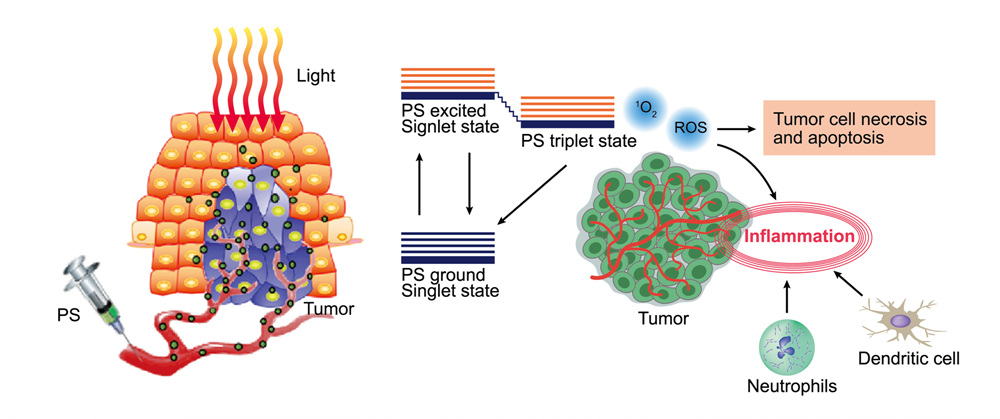
Photodynamic Therapy, PDT
When photosensitizer -accumulated tumor cells are irradiated with a light of certain wavelength, reactive oxygen species(ROS) are generated via photochemical reaction. Generated ROS selectively damage the tumor cells by direct induction of apoptosis and necrosis, and indirect induction of immunological effects, hypoxia and starvation of tumor by damaging the vasculatures of the tumor and its surrounding vessels. These chains of procedures are known as photodynamic therapy(PDT).
Photodynamic diagnosis, PDD
Photosensitizer has a photochemical feature of UV-fluorescence (i.e. 405nm light activates certain 2nd generation photosensitizer to produce red-light). With this photochemical feature of photosensitizer, the tumor loci can be specified during operation. This procedure is known as photodynamic diagnosis(PDD). PDD is expected to increase the surgical success rate by diagnosing traditionally undiagnosable tumor loci during operation, via fluorescence endoscopy/laparoscopy.

| Classic PDT(Conventional PDT) | Interstitial PDT(I-PDT) |
|---|---|
 |
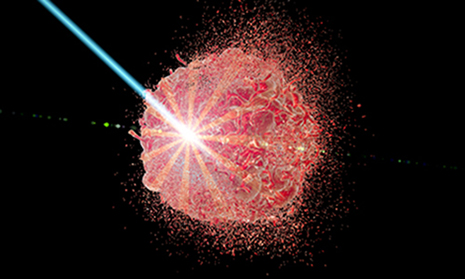 |
| Surface-tumor light delivery | Intra-tumor* light delivery * Fiber optic probe is inserted into the targeted tumor via puncturing with needle |
| Effective in treating tumors that are widely distributed on the surface (e.g. Peritoneal cancer, BCC, etc.) |
Effective in treating locally advanced solid cancers and deeply embedded tumors (e.g. Pancreatic cancer, Brain tumor, etc.) |
| Minimizes side effects by applying the energy(light) only to the tumor cells,but not to the surrounding normal tissue ⇒ Maximizes therapeutic effect |
|
| To maximize the efficacy of energy(light) delivery, selective usage in the type of fiber optic probe according to the morphological characteristics of tumors is necessary. | |

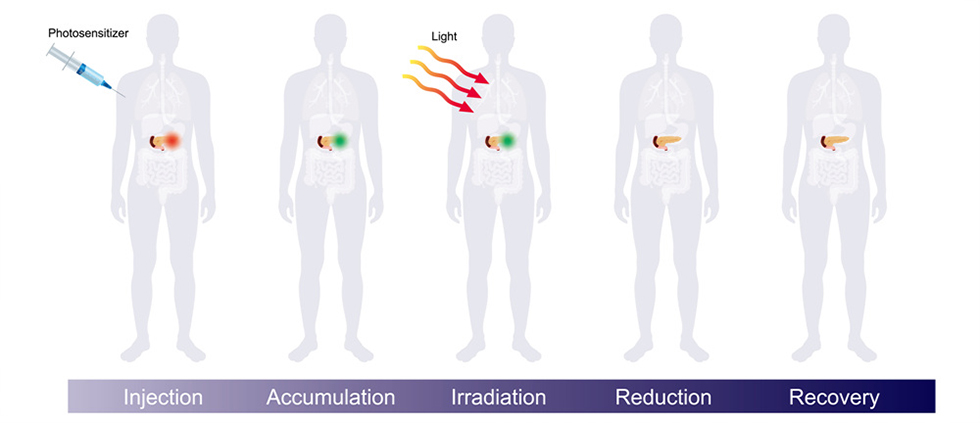
Due to photosensitizer’s light sensitivity, the patient will receive an intravenous infusion of photosensitizer in the darkroom.
After photosensitizer selectively accumulates in the tumor tissue, the patient will be moved to the operating room for PDT.
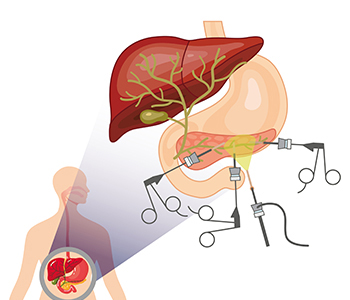
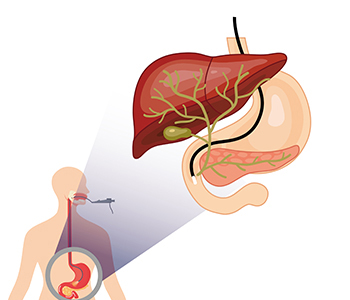
The patient will receive either laparoscopic or endoscopic PDT via a set of laser devices.
ROS(Reactive Oxygen Species), which are generated via photochemical reaction, induces tumor size reduction.
After PDT is complete, the patient must stay in a darkroom to washout the remnant photosensitizer and prevent unnecessary phototoxic reaction.
Patient Guide
ㆍPhotosensitizer should not be used in patients with blood disorders such as porphyria.
ㆍLocal swelling and inflammation in and around the treated area may cause physical discomfort in that area after the treatment.
ㆍAsk your doctor if photosensitizer is right for you.
ㆍPDT will make your skin and eyes sensitive to bright light(photosensitivity), meaning that you can experience effects similar to sunburn if you are exposed to light.
→ You must protect your skin and eyes from sunlight and stay in a darkroom to washout the remnant photosensitizer.
ㆍIf you go out during daylight hours, talk to your doctor and do not leave any part of your body unprotected.
→ Do this by wearing protective clothing, socks, shoes, a wide-brimmed hat, scarf, and gloves.
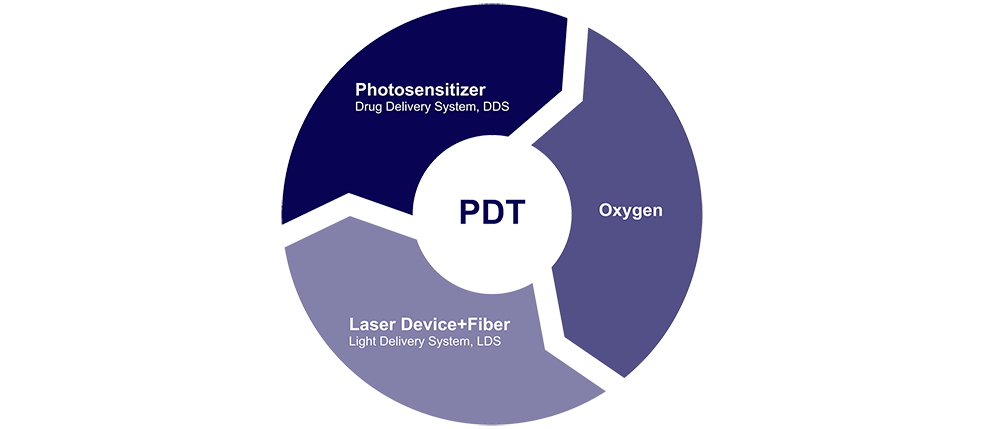

DongSung Bio Pharm is conducting researches to apply the complexes of chlorine e6(Ce6) and polyvinylpyrrolidone (PVP), a 2nd generation Photosensitizer, to various carcinomas.
| Photosensitizer(PS) | 1st generation | 2nd generation |
|---|---|---|
| Maximum Absorbance Wavelength | 630nm | 662-665nm |
| Penetration depth* | 3-5mm | 10-18mm |
| Operable hours after PS administration | 48-72 hours | 1.5-3 hours |
| Drug retention period** | 6-8 weeks | 48-72 hours |
** 2nd generation PS has improved tumor selectivity and shorter retention time compare to 1st generation PS

Fluorescence Laparoscopic System
A system for diagnosing the presence of tumor cells by irradiating a laser of a specific wavelength(405nm) to a photosensitizer-accumulated tumor cells
PDT Laser Device
A light source device that damage tumor cells by generating reactive oxygen species(ROS) due to a photochemical reaction upon laser irradiation at a specific wavelength(665nm) on to the photosensitizer-accumulated tumor cells
Fiber Optic Probes(FOP)
Developed by Taihan Fiberoptics for Interstitial-PDT* procedure (Medical Device Manufacturing License 17-516)
* In interstitial-PDT, one or more fiber optics are inserted into the targeted tissue (i.e. tumor cells). This minimizes the possible side effects and maximizes the therapeutic effects by applying the light energy only to the tumor cells, but not to the surrounding normal tissue

| Specification | TFO-FOP-CT-280/600 |
|---|---|
| Manufacturer | TAIHAN FIBEROPTICS, Korea |
| Core Diameter | 280±2㎛ |
| NA | 0.37 |
| Laser type | CW(Continuous Wave) |
| Fiber diameter | Sillca |
| Illumination length(nm) | 660nm ~ 665nm |
| Input power | 1W |
| Transmission | 80% |
| Fiber connector | SMA905 |
※ Light Delivery System(LDS)
 |
 |
|---|---|
| LAP-guided PDT | EUS-guided PDT |
| ㆍPDT to tumors lying under the deeper region became possible ㆍNo or less scar left after surgery |
|
| ㆍOptimal effect of PDT is expected due to the larger operable region and angle ㆍDeep needle penetration ㆍDeep optical fiber penetration ㆍEasy to control adverse events during procedures (e.g. bleeding) ㆍLarger number of laparoscopy surgeons |
ㆍReduced effect of PDT is expected due to the limited operable region and angle ㆍShallow needle penetration ㆍShallow optical fiber penetration ㆍDifficult to control adverse events during procedures (e.g. bleeding) ㆍLess number of endoscopic ultrasonography surgeons |

| YEAR | CONTENTS |
|---|---|
| 2009 | ㆍExclusive Distribution Agreement with LEMT for a medical laser device for PDT(UPL-FDT) ㆍExclusive Distribution Agreement with Belmedpreparaty for 2nd generation photosensitizer (Photolon®) |
| 2012 | ㆍMarketing approval from MFDS(KFDA) for Laser Device developed by LEMT ㆍKGMP approval for LEMT plant |
| 2015 | ㆍAcquired 2nd generation photosensitizer as Orphan Drug, designation from MFDS ㆍApproved for phase I/II clinical study for a 2nd generation photosensitizer in Pancreatic/Cholangio Ca. |
| 2016 | ㆍObtained KGMP regular inspection for LEMT ㆍAdditional Agreement for exclusive distributorship of 2nd generation photosensitizer (Total 19 countries) |
| 2017 | ㆍCompleted "Daegu Cancer Center" construction ㆍContract for the Transfer of Technology with Korea Electrotechnology Research Institute(KERI) for PDT/PDD system ㆍContract for the Transfer of Technology with AMC, University of Ulsan for therapeutic laser probe |
| 2018 | ㆍBegan 1st year SME support R&D Project with KERI ㆍExclusive Distribution Agreement with Taihan Fiberoptics for Medical Fiber Optic Probes(FOP) ㆍDS Lumax Co., Ltd. Registered trademark for the production of PDD/PDT system (Lubio, 루바이오) ㆍContract for Technology Implementation with KERI for development of fluorescence laparoscopic system and PDT light source technology |
| 2019 | ㆍBegan 2nd year SME support R&D Project with KERI ㆍPublication of International application upon Patent Cooperation Treaty(PCT) procedure; Patent Application No. 10-2016-0133163(KR); Medical light source module, and medical light device having the same ㆍDongSung Bio Pharm-KERI was selected as 'Top 10 Research Results in 2018' for developing ‘Fluorescence Laparoscopy and Photodynamic Technology for the Treatment of Pancreatic Cancer’ |